Retail and e-commerce packs can share a design under the EU’s Packaging and Packaging Waste Regulation (PPWR). The rules distinguish the functions of sales packaging and delivery packaging; they do not require a separate design simply because a product is sold through two channels. Separate versions earn their complexity when the product’s protection, presentation or distribution needs differ enough to justify them.
For a brand selling a skincare set through shops and its own website, the useful question is which layer needs to change. A smaller delivery carton may reduce excess space while preserving a well-fitted gift box. For a robust accessory, making the sales pack suitable for direct dispatch may remove an entire layer. Each choice changes the work that the remaining packaging must do.
Article 3 of Regulation (EU) 2025/40 provides the starting distinctions. Sales packaging forms a sales unit with the products for the end user; this can be a product box sold in a shop or online. Grouped packaging brings sales units together for sale, shelf restocking or stock handling and can be removed without affecting the products. Transport packaging facilitates handling and transport to prevent damage. E-commerce packaging is transport packaging used to deliver online or other distance sales to the end user.
Retail replenishment cartons can therefore also fall within the grouped or transport categories. The outer-pack rule reaches beyond online orders. Although the PPWR generally began applying on 12 August 2026, these minimisation and empty-space provisions have their own deadlines:
| Requirement | Responsible party and duty | Deadline |
|---|---|---|
| Sales-pack empty space — Article 24(4) | The operator filling sales packaging must reduce empty space to the minimum necessary for packaging functionality, including product protection. This paragraph sets no fixed percentage cap. | By 12 February 2028. |
| Packaging weight and volume — Article 10(1) | The manufacturer or importer must ensure the design reduces weight and volume to the minimum necessary for functionality, taking account of shape and material. | By 1 January 2030. |
| Grouped, transport and e-commerce empty space — Article 24(1) | The operator filling the packaging must meet a maximum 50% empty-space ratio, subject to the applicable exemptions. | By the later of 1 January 2030 and three years after the relevant implementing acts enter into force. |
Using the sales pack itself for e-commerce dispatch changes the 50% treatment. Article 24(5) exempts operators using sales packaging as e-commerce packaging from the paragraph 1 cap. That sales pack still has its sales-pack empty-space duty, and the exemption expressly preserves Article 10’s requirements. When the sales box instead travels inside a separate delivery carton, the outer carton falls under the 50% rule and its timetable, unless another applicable exemption covers it.
Article 24(5) also exempts reusable packaging used within a system of reuse from the paragraph 1 cap. A gift box that a customer might keep for storage does not, by that fact alone, meet the condition of use within such a system.
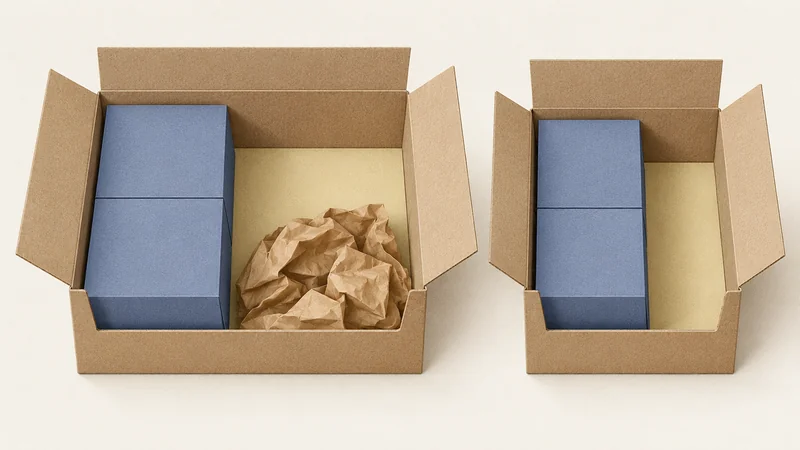
For covered outer packaging, Article 24(3) defines empty space as the total packaging volume minus the volume of the sales packaging contained inside. The ratio is that difference divided by the total outer-pack volume. Filling materials count as empty space, including paper cuttings, air cushions, bubble wrap and foam fillers.
Using illustrative volumes, two sales boxes totalling 2.4 litres in a six-litre delivery carton give a basic empty-space ratio of 60%. A four-litre carton gives 40%. Adding paper to the larger carton does not improve its ratio. The smaller carton is a useful candidate for sampling, provided it still accommodates the products and the protection they need.
Inside the sales pack, Article 24(4) looks at the difference between its internal volume and the volume of the packaged product. A closely fitted shipping carton can therefore have a low outer empty-space ratio while enclosing an unnecessarily large gift box. The outer percentage and the inner minimisation assessment need separate attention.
The regulation requires the Commission to establish the calculation methodology by 12 February 2028, accounting for irregular shapes, multiple sales packs, liquids, damage risks and space for shipment labels. Use simple volume comparisons to select prototypes; formal outer-pack calculations need the applicable implementing methodology. Its entry into force also determines the three-year timing trigger: an act entering into force in 2028, for example, would put that point in 2031. The Commission’s guidance on Article 24 separately confirms that sales-pack empty space has no predefined percentage threshold.
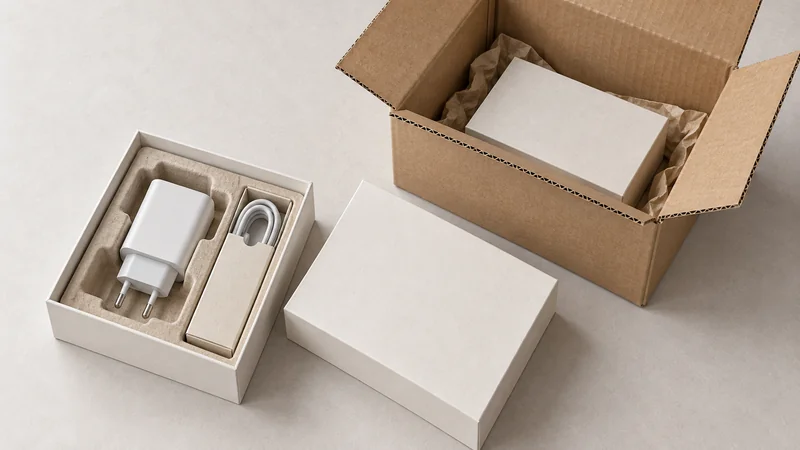
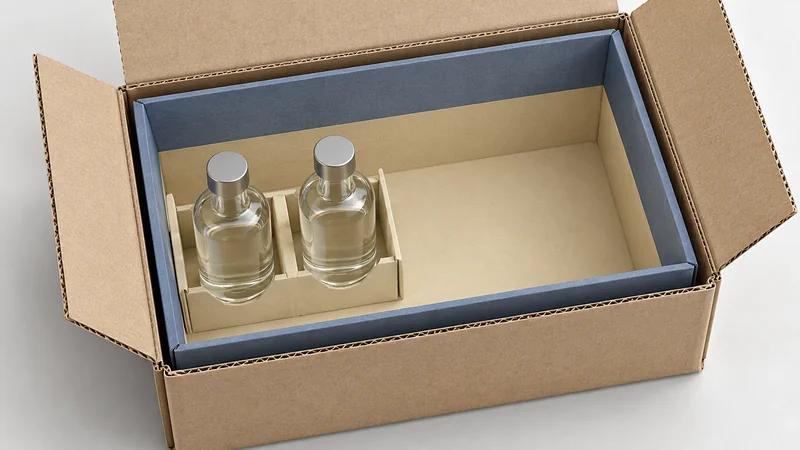
A shared sales box with a fitted shipping carton is often a useful starting point for fragile or giftable products. Consider two glass skincare bottles sold together as one gift set. The insert keeps them apart and holds them in position for opening. The delivery carton can provide protection during handling while shielding the gift box from labels, dirt and abrasion. These layers perform different jobs, each with its own weight and volume to justify.
At CMIC, we can develop those layers together: check the product clearances, explore a shallower insert and match the shipping carton to the resulting sales box. A tray that controls movement may allow a more compact arrangement. Making it too tight, however, can make removal awkward or put pressure on vulnerable parts of the product. Filled samples help establish where useful restraint becomes a poor fit.
This route preserves one sales-pack artwork version and a common pool of stock for both channels. It still needs shipping options that fit actual orders: one gift set, two sets, or a set alongside a smaller item. The carton selected for the largest combination may leave excessive space around the smallest order. A small range of suitable cartons, with clear packing instructions at fulfilment, can address that problem without creating another branded sales box.
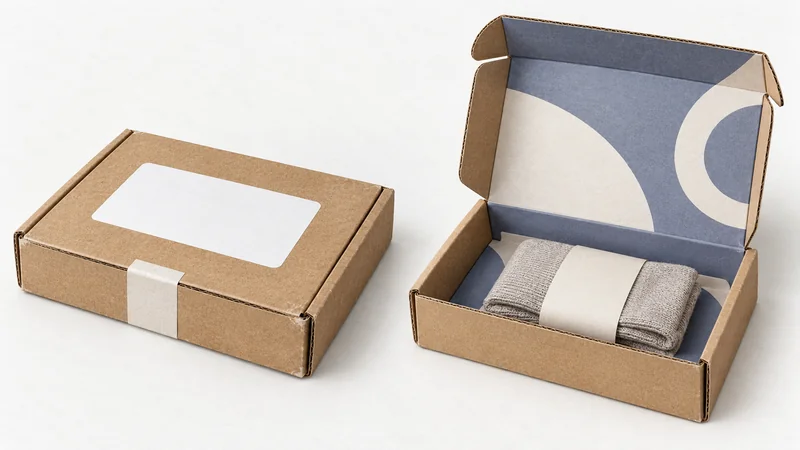
A sales pack designed for direct dispatch can work well for a compact, robust accessory. A fabric watch strap, for example, may need secure containment and protection from abrasion rather than the cushioning required by glass. A suitably designed corrugated sales pack could provide that protection and carry the shipping label, allowing the product to travel without a second box.
The exterior then becomes the parcel surface. Labels, tape and handling marks become part of what arrives at the customer’s door. A dedicated label panel, secure closure and considered interior graphics can make that experience intentional. Check the required shipping label on the sample early: for a very small product, it can determine how much usable flat surface the pack needs. A brand expecting an untouched gift exterior may still prefer a protective outer layer.
Compare the reinforcement across both channels. If direct dispatch requires thicker board in every sales pack, retail units carry that extra material too. For online orders containing several products, the reinforced packs may end up inside another carton anyway. The useful comparison is the total packaging used for each realistic order and distribution route, including inserts, wrapping and closures.
Separate retail and online versions become attractive when their required functions diverge substantially. A robust accessory might use a light hanging carton in shops and a compact, closed mailer online. Making the hanging carton suitable for parcel handling could add awkward structural features and material to every retail unit. Separate structures let each pack serve its journey, while shared colour, typography and opening details preserve a recognisable brand experience.
The cost extends beyond a second print run. Two designs can mean additional tooling, samples, artwork approvals, purchasing quantities and stock forecasts. An online promotion may exhaust the mailer version while retail packaging remains unused. The case for separation is strongest when improvements in protection, material use or order fit justify that extra inventory and version control. Changing the artwork alone leaves the underlying space problem intact.
Across all three routes, the difficult judgment is what packaging is necessary. Annex IV recognises product protection, manufacturing and filling processes, logistics, information, safety and other performance criteria. Its packaging-functionality criterion expressly includes sales for gift purposes and seasonal events. A gift pack therefore has a function to assess alongside protection and handling; the assessment considers what weight and volume are needed to deliver those functions.
A separator that stops two glass bottles striking each other has a clear protective purpose. A raised platform whose only purpose is to make the contents look larger presents a different question. Article 10(2) targets features intended only to increase perceived product volume, including double walls, false bottoms and unnecessary layers. For an ordinary gift pack, proportion, print, texture and the opening movement can carry much of the presentation, while added structure needs a functional basis.
A useful comparison brings these choices back to filled samples and the actual journey. We can prepare alternative structures, compare their dimensions and weights, and arrange suitable transit testing with agreed product-damage and arrival-condition criteria. For the skincare set, that means examining bottle movement and breakage risks as well as the condition of the gift box. For the accessory, closure security, label placement and opening after delivery may reveal more than an attractive empty sample.
The resulting specifications and findings also support the wider PPWR packaging minimisation assessment. Annex IV calls for calculations of minimum necessary weight and volume, consideration of production-batch variations, and explanations of the requirements preventing further reduction, together with any test results, market research or studies used. Record why a particular clearance, insert or wall thickness remains necessary, so the reasoning survives beyond the approved sample.
That reasoning needs to reach the people filling each layer. Article 10 addresses the manufacturer or importer; Article 24 assigns the relevant filling duties to the operator filling the packaging. For packaging made in China for EU sales, the physical packaging supplier, brand and fulfilment business may occupy different roles. A compact approved sales pack can still be placed into an oversized carton at a warehouse. Agreed carton options and packing configurations connect the design work to what is actually dispatched.
If you are deciding whether to split a packaging range, share your current pack, product details and typical online orders with us. We can develop a small number of complete packing options and help compare their size, material use, protection and arrival condition before you commit to another packaging version.