A skincare jar can work perfectly for the formula yet leave unresolved questions about its plastic lid, retail carton and gift box. Changing the jar may then change the insert, the box dimensions and the protection needed for delivery. For cosmetics and skincare brands, PPWR calls for decisions across these connected parts of the pack.
The EU Packaging and Packaging Waste Regulation, Regulation (EU) 2025/40, generally applies from 12 August 2026, including to packaging imported into the EU. As of September 2026, that date has passed, but several major design requirements have later start dates. The useful task now is to establish which requirements apply to your packaging today and which should shape the next container, artwork or structural investment.
What needs attention now, and what comes later?
| Timing | Relevant requirement | Meaning for a beauty brand |
|---|---|---|
| Since 12 August 2026 | General application, including manufacturer conformity duties for applicable requirements, identification and substance provisions. | Confirm responsibilities and connect the supplied packaging to its specifications and supporting evidence. |
| By 12 February 2028 | Operators filling sales packaging must minimise empty space while preserving functionality, including protection. | Review unnecessary gaps in individual retail packs and gift sets classified as sales packaging. |
| 12 August 2028 or 24 months after the relevant implementing act enters into force, whichever is later | Harmonised material-composition labelling, subject to specified exclusions. | Plan for future artwork changes without confusing these labels with current identification duties. |
| From 1 January 2030 | Article 10 weight-and-volume minimisation; targeted restrictions on certain packaging formats. | Develop a functional basis for pack size and construction, and review affected accommodation toiletries. |
| 2030, with separate later-date triggers | Design-for-recycling grades, minimum recycled content in plastic, and the 50% empty-space rule for specified outer packaging. | Check the trigger for each requirement before treating 2030 as a fixed approval deadline. |
The later Article 10 date does not create a pause in minimisation obligations: the Commission’s guidance on packaging minimisation explains that existing requirements continue through 2029. Packaging changes must also continue to satisfy relevant product safety, quality, hygiene and transport requirements. A lighter container is only a useful option if it still protects the formula and works as intended.
Separate plastic recycled content from recyclability
These requirements answer different questions. Recycled content concerns the material used to make the packaging. Recyclability concerns its suitability for material recycling after use. A bottle containing recycled plastic still needs a recyclability assessment; a recyclable bottle does not automatically meet a recycled-content target.
PPWR’s definition of contact-sensitive packaging includes packaging intended for products covered by the EU Cosmetics Regulation. Article 7 sets the following minimum post-consumer recycled-content targets for the relevant plastic categories. Specific components and additional packaging layers still need classification before a percentage is assigned.
| Contact-sensitive plastic category | Initial minimum | Minimum from 1 January 2040 |
|---|---|---|
| Packaging with PET as the major component, excluding single-use plastic beverage bottles | 30% | 50% |
| Packaging made from plastics other than PET, excluding single-use plastic beverage bottles | 10% | 25% |
The initial targets apply from 1 January 2030 or three years after the Article 7(8) implementing act enters into force, whichever is later. The percentages concern plastic parts and are calculated by packaging type and format as an average per manufacturing plant and year. They are not recycled-paper targets for a carton, recycled-glass targets for a jar, or necessarily a percentage measured in every individual bottle.
A glass jar’s plastic lid or pump still deserves attention. Article 7 excludes a plastic part representing less than 5% of the whole packaging unit’s total weight from its minimum recycled-content targets. Applying that exception requires an appropriate packaging-unit boundary and reliable part weights. It does not exempt the part or pack from other PPWR requirements, and adding an unrelated outer box to the calculation is not a sound assumption.
For the brand, the consequential choice is whether the proposed material works with the product. A change in resin or recycled feedstock may warrant renewed compatibility, appearance, closure or dispensing checks. Ask the container supplier to identify the proposed material, the evidence supporting its recycled-content claim and the checks relevant to your formula. Where feedstock is collected or recycled outside the EU, PPWR’s equivalence conditions also matter; overseas origin alone neither establishes nor rules out eligibility.
Assess the container, dispenser and decoration together
A material name describes only part of a beauty pack. A bottle may also have a sleeve, label, adhesive, closure and pump; a gift box may contain an insert, lining and magnetic closure. Article 6 addresses integrated components within the packaging assessment and separate components through separate assessment. This makes the actual construction important: calling the main body “paper” or “PET” does not establish conformity.

Useful alternatives might include a dispenser with fewer material combinations, a different label construction, or a paper insert replacing a bonded mixed-material insert. Each needs to preserve its job. A simpler pump must still dispense reliably; an insert must still hold the jar; decoration must be assessed as part of the chosen construction. Reducing material variety can be a promising direction, but it is not itself a legal recyclability result.
Design for recycling concerns how the packaging’s materials and construction affect its suitability for material recycling. PPWR uses recyclability performance grades for this assessment; these concern the pack’s recycling performance after use, rather than its recycled content when manufactured. The later recycled-at-scale requirement adds a practical condition: packaging must also be collected, sorted and recycled at the required scale. For a beauty brand, both the proposed construction and the recycling systems that can handle it matter to a lasting design choice.
Under Article 6, packaging generally needs recyclability Grade A, B or C from 1 January 2030 or 24 months after the relevant delegated acts enter into force, whichever is later, subject to applicable exceptions. From 2038, the accepted grades narrow to A or B. The recycled-at-scale requirement starts on 1 January 2035 or five years after the relevant implementing acts enter into force, whichever is later. Before investing in long-lived tooling, ask suppliers how the proposed construction will be assessed for design suitability and what recycling route would support it in practice. Those explanations give an unsupported “2030 compliant” description something concrete to be checked against.
Can you keep the retail carton or premium gift box?
A carton or rigid gift box needs a reasoned assessment of its function and construction. Article 10 requires packaging weight and volume to be reduced to the minimum necessary for functionality. It also addresses features aimed only at increasing perceived product volume, such as false bottoms, double walls and unnecessary layers. Premium positioning alone does not justify additional bulk.
There is room for a more thoughtful answer than removing every outer box. Annex IV explicitly recognises gift and seasonal purposes within packaging functionality. It also recognises protection, manufacturing and filling, logistics, information, hygiene, safety and other relevant criteria. A carton may carry necessary information or protect a vulnerable container; a gift box may organise several products into a usable presentation. The assessment must explain what prevents further reduction.
That recognition is not an exemption for decorative bulk. The Commission explains that marketing and consumer acceptance were removed as independent reasons for extra weight and volume. A wide border around a small cream jar therefore needs closer scrutiny than space needed to prevent two glass containers striking each other. Likewise, replacing a plastic insert with a much larger paper insert does not, by itself, demonstrate minimisation.
For a beauty brand, this shifts the design conversation toward proportion, fit and purposeful detail. A closer-fitting structure, well-chosen surface texture, controlled colour and a considered opening movement can carry presentation without relying on a large footprint. Finishes still need review for their effect on the complete construction. Neither a folding carton nor a rigid box is automatically the right answer: the product, distribution conditions and gift function determine which options deserve development.
Consider a serum-and-cream gift set. Changing the cream jar to a narrower format may allow a narrower box, but only after checking the serum bottle’s position, the separation between the products and the room needed to lift them out. Removing individual cartons may reduce layers while creating a new need for product information or protection. A shallow paperboard insert and a deeper formed insert can be compared for fit and handling; their materials, weight and recyclability implications belong in the same decision.
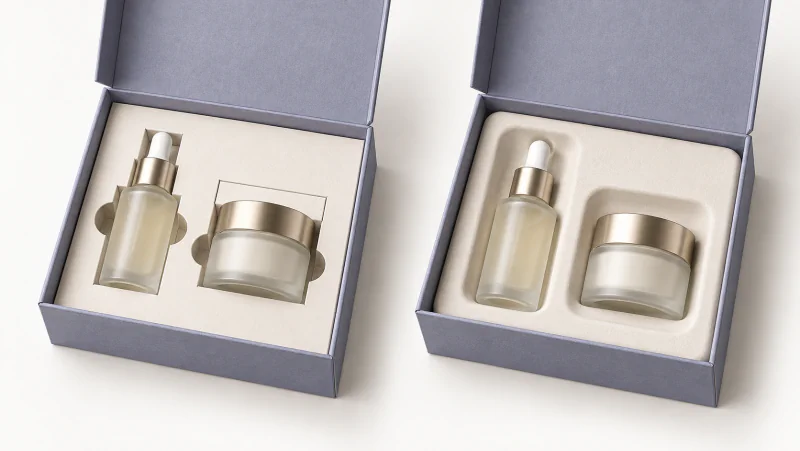
This is where we can help at CMIC: develop alternative paper structures around the proposed containers, compare materials and finishes, and sample the promising directions. Container dimensions and tolerances need to come from the relevant supplier so the insert is not developed around an approximate outline. Protection checks can then address the intended distribution route, and the chosen structure can be recorded in an agreed specification. The brand retains approval of the presentation and the appropriate product specialists retain responsibility for formula safety and compatibility.
Which empty-space rule applies to a gift set or online order?
PPWR distinguishes packaging by function. A gift box’s name, material or decorative finish does not settle its classification. The following distinctions matter because sales-pack empty-space minimisation, the 50% outer-packaging rule and Article 10 minimisation are separate requirements.
| Function | Beauty-pack example | Empty-space consequence |
|---|---|---|
| Sales packaging forms the sales unit offered to the final user. | An individual cream carton, or a gift box forming one retail set. | By 12 February 2028, the filling operator must minimise empty space while ensuring functionality. Article 24(4) does not impose a universal 50% limit on these packs. |
| Grouped packaging groups a number of sales units. | An outer pack grouping individually saleable skincare products, where it performs that function. | The maximum 50% rule applies to the filling operator at its statutory start date. |
| Transport packaging supports handling and transport; ecommerce packaging is transport packaging used for distance-sale delivery. | A shipping case or parcel box carrying an online beauty order. | The maximum 50% rule applies to the filling operator at its statutory start date, subject to the relevant exemptions. |
For grouped, transport and ecommerce packaging, the maximum 50% empty-space ratio starts on 1 January 2030 or three years after the relevant implementing acts enter into force, whichever is later. Filling material counts as empty space. Adding tissue, paper cuttings, foam or air cushions therefore does not make an oversized parcel satisfy the ratio. The practical direction is to improve the relationship between the outer pack and its contents while retaining necessary protection.

Article 24(5) provides an exemption from that ratio obligation for operators using sales packaging as ecommerce packaging, or reusable packaging within a reuse system. Relevant sales packaging must still meet Article 10. If a gift box is intended to ship directly to the customer, its classification and obligations should therefore be reviewed alongside its ability to survive delivery; omitting the shipping box is not automatically a complete solution.
Evaluate refill as a complete product system
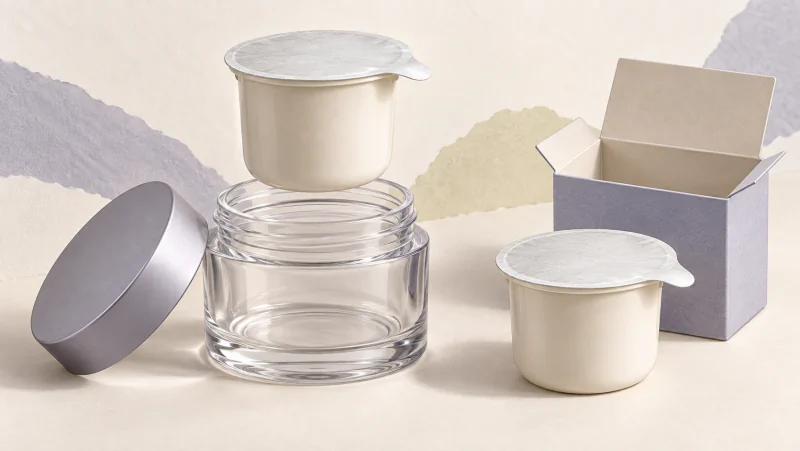
A durable jar with a replacement pod can be attractive when it gives customers a reliable way to keep using the outer pack. Article 11’s reusable-packaging conditions include intended repeated use, repeated rotations, safe emptying and refilling, product quality, hygiene, reconditioning, information and eventual recyclability. Calling a container “refillable” does not establish that these conditions are met.
The product decisions follow from those conditions. Can customers replace the pod without contaminating the formula? Will the closure or dispensing mechanism continue to work? What cleaning or handling instructions are needed? The replacement pod or refill pouch remains packaging in its own right, with requirements determined by its construction and use. Its barrier needs, seals and additional shipping packaging should be considered alongside the durable container.
The sales channel also matters. From 1 January 2030, PPWR restricts specified single-use cosmetic, hygiene and toiletry packaging in accommodation, including the individual-booking formats intended for disposal before the next guest. This is a targeted accommodation rule, not a blanket ban on every retail travel size or miniature. Brands supplying hotels should review those formats separately from their ordinary retail range.
Agree who is responsible—and what suppliers must provide
The physical packaging factory is not automatically the PPWR manufacturer. Under the own-name or trademark rule, a business commissioning packaging or a packaged product under its name can hold that role. Micro-enterprise provisions and the actual supply arrangement can affect the outcome. A brand sourcing packaging from China should therefore establish the roles of the commissioning business, packaging suppliers, filler and EU importer before assuming that one supplier’s declaration settles the whole arrangement.
Article 15 requires the responsible manufacturer to carry out conformity assessment, prepare technical documentation and issue an EU declaration once conformity with the applicable requirements has been demonstrated. Suppliers must provide necessary information and documentation, and importers have verification duties. The ordinary conformity route uses internal production control; it does not require every packaging format to receive a notified body’s “PPWR certificate.”
- Identify the construction: drawings, dimensions, component weights, materials, finishes and the approved version.
- Connect evidence to that construction: relevant material declarations, substance information, test reports and assessments with a clear scope.
- Explain functional choices: the protection, information, handling or gift requirements that support the design and any limits on further reduction.
- Control changes: define how a different resin, coating, adhesive, insert or supplier will be reviewed before substitution.
The purpose is to make the approved pack and its evidence match. A report for a different coating or an earlier container version may not answer the question about the current pack. Article 15 requires reassessment where changes could affect conformity, and retention of the technical documentation and declaration for five years for single-use packaging and ten years for reusable packaging.
Substance evidence is one part of that record. Article 5 generally limits the combined concentration of lead, cadmium, mercury and hexavalent chromium in packaging or components to 100 mg/kg, subject to applicable derogations. A report addressing that limit does not establish recyclability, minimisation or complete PPWR conformity. The specific PFAS thresholds in Article 5(5) concern food-contact packaging; cosmetic contact-sensitive status does not make a cosmetic pack food-contact packaging or remove other applicable chemical obligations.
Extended producer responsibility, or EPR, is another distinct task. It concerns responsibilities for packaging waste, and the identity of the EPR producer depends on the supply arrangements in each Member State. Destination-specific registration and reporting need their own review; the packaging’s EU declaration does not settle them.
Plan artwork around current identification and later labels
Current identification duties and future harmonised sorting labels serve different purposes. Article 15 allows a type, batch, serial number or another identifying element, with accompanying-document relief where the packaging’s size or nature prevents marking. Manufacturer contact details have specified placement routes, including packaging or a data carrier. These provisions do not require a unique serial number and QR code on every cosmetic pack.
The harmonised material-composition label under Article 12 has its own start date: 12 August 2028 or 24 months after the relevant implementing act enters into force, whichever is later. Specified exclusions include transport packaging other than ecommerce packaging and packaging covered by deposit-return systems. Conditional alternative placement and electronic-information routes exist where size or nature makes ordinary marking impossible or unwarranted. They are not general permission to remove mandatory cosmetic-product information.
For a small serum carton, this is a reason to review the information layout early. Preserve readable product information, establish the appropriate identification route and allow for later packaging-label changes. Resolving those needs during structural development is easier than discovering after artwork approval that the chosen panel cannot accommodate them.
Turn the review into a packaging brief that can be developed
Start with one existing product or planned launch. Bring together the container and dispenser specifications, the formula-related constraints, the retail or gift purpose, the EU destinations and the delivery route. Add the presentation qualities you want to retain. Those details allow a packaging team to compare meaningful alternatives: a closer-fitting carton, a revised gift insert, a different finish, or a box designed for a more specific order size.
At CMIC, our core contribution is developing the paper packaging around those needs and coordinating the connected work. We can explore structures and materials, prepare samples, align specifications with container suppliers and arrange suitable specialist testing where needed. Adjacent containers or components can be assessed through supply-chain partners. The result should be a pack whose appearance, fit, protection and supporting information refer to the same approved construction.
Our EU packaging solutions explain how that support can fit a project. To discuss an existing beauty pack or a new launch, share your product and packaging brief with us. A useful next design preserves what the product and customer need while giving each material, layer and dimension a clear purpose.