Yes, plastic windows can make paper boxes harder to recycle. The film and its adhesive add materials for the recycling process to handle, and some usable paper fibre can be lost along with them. But a window does not automatically make the whole box unrecyclable.
For a brand choosing paper boxes with plastic windows, the useful question is how the complete design behaves after use: can it reach an appropriate recycling stream, release its fibres and produce useful recycled paper? That brings the film, the bond and the rest of the box into the decision, alongside the recycling system where customers discard it.
From the recycling bin to recovered paper
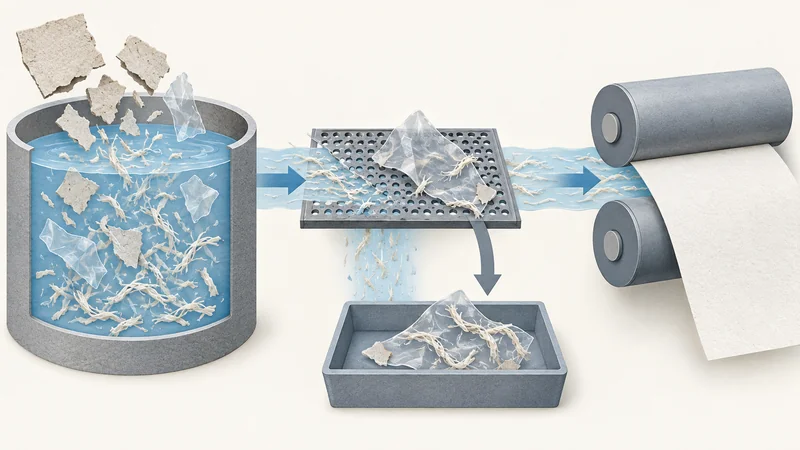
A collection instruction answers the first question: where a discarded box belongs. Sorting then directs collected packaging towards suitable recycling processes. A paper mill’s job is to recover useful fibres, so other materials attached to the board need to be removed or be compatible with that process.
- Pulping: Water and mechanical action break the paperboard down into a fibre suspension. How readily the fibres separate depends on the board and its coatings and bonds.
- Screening and cleaning: Screens and other cleaning equipment remove unwanted material. A plastic window may be captured as a reject; fibres still attached to it can be lost too.
- Papermaking: Recovered fibres become new paper or board. Tacky residues that escape cleaning can cause defects or accumulate on papermaking equipment.
Removing a film successfully can therefore help the paper fraction recycle while the film itself leaves as waste. Recycling that film would require a further recovery route. This distinction matters when interpreting a test result or writing a packaging claim: good fibre recovery does not establish that every material in the box becomes a new product.
Collection rules are local. Rhode Island Resource Recovery lists cardboard boxes with plastic windows as accepted in its mixed recycling programme and requires cardboard to be flattened and loose. That is guidance for Rhode Island, US. It establishes local collection acceptance, rather than an EU-wide rule or proof that the window itself is recycled.
The film and the bond work as one design
Quantity means the whole patch. The film usually overlaps the opening to provide a bonding margin. Its mass depends on the full patch dimensions, thickness and material, including the portion hidden behind the board. Reducing unnecessary overlap can reduce film use, provided the attachment remains reliable.
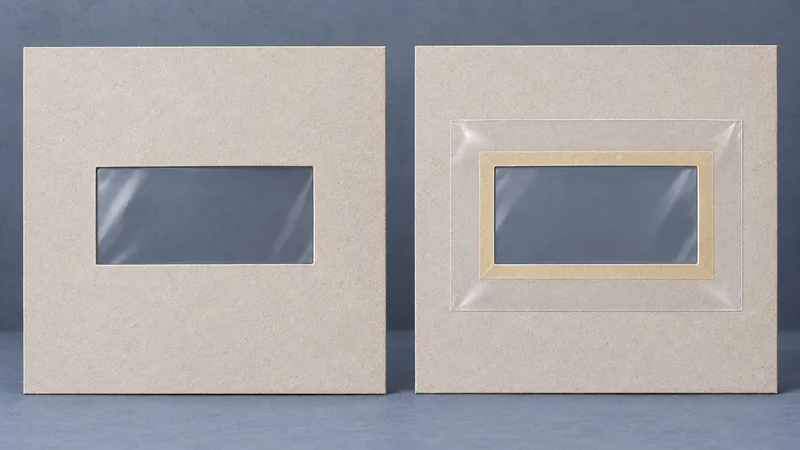
A plastic percentage also needs context. The same window represents a smaller share of a heavy rigid gift box than of a lightweight folding carton. A heavier board can lower that percentage without changing how the film or glue behaves during recycling. Material proportions are useful information, but they do not describe separation or fibre loss on their own.
Film behaviour affects separation. The useful sequence is for fibres to release, then for unwanted film to be removed efficiently. Film that remains in pieces large enough for the mill’s screens can be easier to remove than fine fragments. This makes the specific film grade, its coatings and its behaviour under the relevant pulping conditions important parts of the comparison.
Attachment can change how much fibre is recovered. A bond that keeps paper fibres attached to the window can send them out with the rejects. Certain adhesive applications can also create tacky particles, often called stickies, that interfere with papermaking. Even a small amount of adhesive can therefore matter beyond its own weight.
Laboratory work on paper–polymer laminates published in Paper Technology illustrates this mechanism: some adhesive combinations allowed fibres to separate, while others retained fibre in screened-out material. Those results concern the tested laminates and conditions. For a windowed box, the useful evidence concerns the finished bond between the chosen film and board; descriptions such as water-based or solvent-free are too broad to establish its recycling performance.
Keep the view the product needs
A window can let someone judge an actual colour, texture or product arrangement before opening the pack. Start with that job. A nail-polish carton may need only a view of the colour through the bottle; a gift set may rely on seeing the arrangement of several pieces. Those are different reasons for choosing the opening’s size and position.
| Approach | What it offers | What to weigh |
|---|---|---|
| Printed, enclosed box | Complete enclosure, with a product image conveying appearance. | Removes the window film and its attachment. Other coatings, finishes and inserts still influence recyclability. |
| Open aperture | A direct view without transparent film. | Allows dust and contact through the opening. Consider product exposure and whether extra protection would be needed elsewhere. |
| Smaller fixed window | A view of the detail that helps the purchase, with film covering the opening. | Reduces film use if the full patch dimensions are reduced too. The film and adhesive still need to suit the intended recycling process. |
| Removable window panel | Visibility during sale and an opportunity to separate materials afterwards. | Needs accessible removal and reliable release. The detached film needs disposal instructions appropriate to the destination. |
For the nail-polish carton, we can compare a narrow front window with a larger opening that extends around a corner. The larger opening removes more supporting board and may require a wider patch or a revised structure. Sampling both with the bottle in place reveals whether the extra view earns the extra construction. Where a narrow window shows the shade clearly and preserves protection, it is a sensible starting point.

Make removal a realistic action
A peelable window is useful when the person emptying the box can find an edge and remove the film cleanly. A tab accessible after opening, a clear pull direction and an adhesive pattern developed for release can make the action easier. Film trapped between layers of a rigid lid may be technically separable yet awkward to remove without tearing the lid apart.
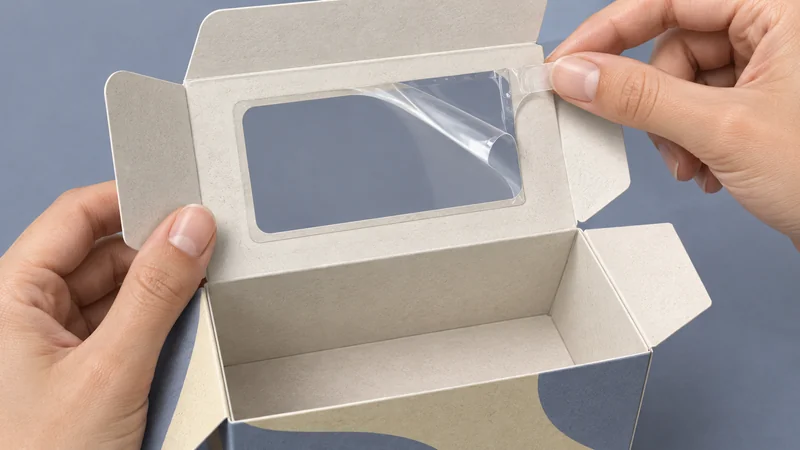
The attachment also has to survive packing and distribution. Sample evaluation should therefore consider peel behaviour alongside handling, fit and appearance, including whether paper tears away with the film. Where consumer removal is part of the proposed recycling route, assessing the attached configuration also shows what happens if that step is skipped.
Separation can improve the paper fraction even where the detached film has no local recycling route. Disposal instructions should make the destination of each part clear and reflect the collection system involved. A removable design creates an opportunity for separation; recycling the film remains a separate question.
What about cellulose or compostable films?
A cellulose-based transparent film can be worth exploring. Its recycling performance depends on the finished film, including any coatings, and on its attachment to the board. Sharing a cellulose origin with paper does not establish that the assembled box will release useful fibres cleanly. The meaningful comparison uses the exact alternative material in the proposed construction.
Bio-based describes where the feedstock comes from; compostable concerns breakdown under specified biological conditions, with industrial and home composting requiring different evidence. Those descriptions answer different questions from whether a paper mill can recover usable fibre from the box. For a retail carton or gift box intended for paper recycling, the relevant evidence is its performance in that recycling route.
What PPWR means for a windowed box
For the EU market, Article 6 of the Packaging and Packaging Waste Regulation (PPWR) links recyclability to material recovery, separate collection, sorting and recycling at scale. Integrated components are included in the packaging unit’s assessment. All components must be compatible with established collection, sorting and recycling processes without hindering the main body’s recyclability. The window and its attachment therefore belong in the assessment of the box.
Article 6 requires detailed design-for-recycling criteria through delegated acts by 1 January 2028. The main design-for-recycling requirement applies from 1 January 2030 or 24 months after the relevant delegated acts enter into force, whichever is later. The recycled-at-scale requirement follows from 1 January 2035 or five years after the relevant implementing acts enter into force, whichever is later. Voluntary industry guidance can inform design work; formal PPWR grading follows the applicable legal criteria and assessment method.
The 5% figure is not a window allowance. PPWR’s definition of composite packaging concerns manually inseparable material combinations and includes a limited exception for an insignificant material representing no more than 5% of the packaging unit’s total mass. This is a classification provision, rather than permission to add 5% plastic regardless of recycling behaviour. Adhesives are excluded for this classification, but their effects remain relevant to the recyclability assessment.
Develop the complete box, then evaluate it
At CMIC, we can develop the viewing opening, structure, film and attachment together, comparing samples against your product’s visibility and protection needs. For EU-bound projects, our EU packaging solutions can also include coordinating appropriate evaluation around the destination markets and intended recycling route.
A meaningful evaluation uses a representative finished box, with its actual film grade, patch dimensions, adhesive application and other relevant finishes. Testing bare board answers only part of the question. The evaluation should identify the recycling process being represented and explain material recovery, rejects and the quality of the recovered fibre or resulting paper. Collection and sorting need to be considered alongside those technical results.
Keeping those material and attachment choices in the approved specification also makes later substitutions easier to assess. A change of film coating or adhesive can alter the bond even when the finished box looks the same. Connecting the sample, specification and evaluation helps preserve the performance the design was selected to achieve.
If a clear view helps someone choose your product, it is worth developing carefully. Talk with us about the product, the view you want and the countries where it will be sold. We can explore a smaller window, a removable panel or another structure, and develop the material combination around those needs.