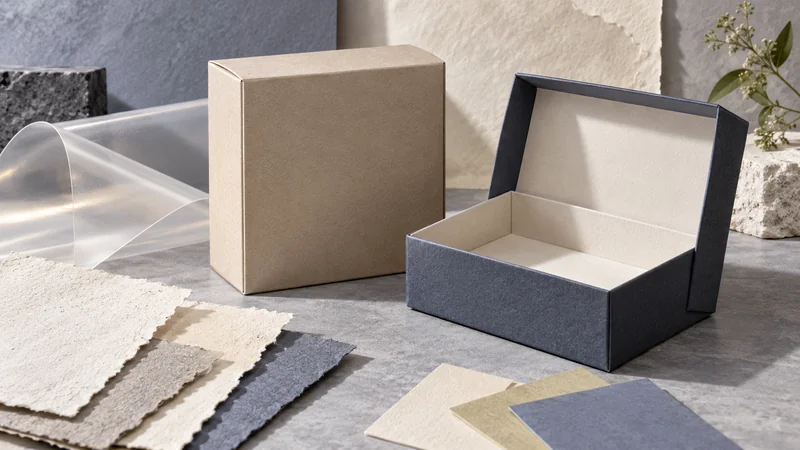
A gift box closes with a quiet magnetic snap. A window reveals the shade of a product. An insert holds a bottle upright as the lid lifts. These details have jobs: they shape presentation, protect the contents or help someone choose what to buy. Redesigning paper packaging for recyclability starts with understanding which of those jobs still matter—and finding constructions that can deliver them.
For a brand selling into the EU, the useful approach is to connect three questions: what must the package do, what will enter the recycling route after use, and what evidence supports the proposed construction? The surface treatment, attachments, insert and finished assembly all affect the design you need to evaluate.
CMIC Packaging can help turn those questions into material options, structural designs and samples, then coordinate appropriate specialist assessment. Your contribution is knowledge of the product and the experience you want customers to have. The development work should make the choices easier to judge.
What PPWR means for a paper-packaging design
The EU Packaging and Packaging Waste Regulation, Regulation (EU) 2025/40, generally applies from 12 August 2026. The European Commission’s overview confirms that EU packaging rules cover packaging regardless of material or origin. Paper packaging manufactured in China for products sold in the EU therefore belongs in this planning conversation. The general application date does not bring every later requirement into effect at once.
“However, the detailed design-for-recycling requirements will apply from 1 January 2030, or 24 months after the relevant delegated acts enter into force, whichever is later.”
Food & Drink Federation, PPWR Business Guidance, Recyclable Packaging (Article 6)
FDF guidance and Keller and Heckman’s legal commentary also explain a later requirement for recycling at scale: 1 January 2035 or five years after the relevant implementing acts enter into force, whichever is later. These are conditional planning milestones, subject to the applicable scope and exemptions. A product-specific compliance decision needs the rules in force for that package and date.
The distinction matters to design. Design for recycling considers compatibility with established collection, sorting and recycling processes. The later recycling-at-scale assessment concerns whether recycling occurs through operating infrastructure at the required scale. The construction and the recycling system both matter.
Follow the package after use: it needs a collection route, sorting into an appropriate material stream and a recycling process suited to the construction. These are connected questions. A favorable assessment of how a sample can be processed does not, by itself, tell you whether the intended market collects and sorts it into that process.
Design determines what reaches those stages. A coated sheet carries its surface treatment with it. A window left attached travels with the carton; one removed before disposal becomes a separate piece needing its own destination. Building a pull into a paper structure removes the need to account for a separate ribbon. These observations give redesign a useful direction: simplify the combination entering a recycling route, or make a necessary separation workable. Whether either change improves recycling performance depends on the resulting construction and route.
Give each feature a purpose before choosing its replacement
An existing sample is a useful starting point because it makes priorities visible. Does the finish need to survive repeated shop handling? Does the window help shoppers distinguish variants? Is the ribbon needed to lift the product, or simply part of the decoration? A feature can have several purposes, and its replacement needs to address the ones you value.
Separate essential performance from preferences that have room to move. For a fragrance gift set, keeping glass bottles apart may be essential; the exact insert color may be flexible. For a jewelry box, the reveal and ease of lifting a delicate chain may deserve as much attention as the exterior. This gives CMIC a useful brief for developing alternatives without asking you to specify every material or attachment.
It also gives material reduction a practical basis. FDF describes the PPWR’s packaging-minimization provisions as limiting weight and volume to what is necessary for functionality from 1 January 2030. Product protection remains relevant to that assessment. During development, compare whether a smaller footprint, closer fit or fewer pieces can preserve the functions the product actually needs.
Surface treatments: compare the finish you need to live with
A surface brief such as “premium matte” leaves several decisions unresolved. It could mean low glare, a particular feel in the hand, a deep printed color or an exterior that remains presentable after handling. Naming those qualities makes it possible to explore different routes: a laminated printed wrap, a coating on the selected stock, or an unlaminated paper whose own color and texture carry more of the design.
For a dark presentation box, compare samples under the same light and handle them as a customer or store team would. Look at fingerprints, visible rubbing, corners, folds and the appearance of the logo. If the box will travel inside a protective outer pack, distinguish the protection needed during delivery from the surface qualities needed after unpacking. That can open up choices that an undifferentiated request for a “durable finish” would miss.
CMIC can explore alternative papers and finishes and coordinate samples with relevant suppliers. The comparison should make the compromise explicit: a different tactile character, a change in color appearance, a revised artwork treatment or a different level of resistance to handling. A finish that looks convincing on a flat swatch still needs to be judged on the folded carton or wrapped box you intend to buy.

Decoration deserves the same attention. A foil logo, printed metallic effect and embossed mark offer different visual experiences. If a small focal detail carries the brand identity, explore whether it can take the place of a more extensive treatment. Compare legibility, reflected light and touch on the actual paper. Reducing the decorated area changes the extent of that treatment; substituting a different effect changes the materials or construction. Those are different proposals to evaluate.
Surface treatments matter to recycling because they remain part of the sheet presented for processing. Replacing a film laminate with a coating removes that film from the proposed construction but introduces the question of how the coated paper performs. An unlaminated wrap likewise removes the lamination question while leaving its inks, adhesives and any other treatments to consider. The useful comparison is whether the complete alternative works in the intended recycling process. CMIC can obtain the material specifications and coordinate that assessment; “water-based,” “plastic-free” and “recycled” alone do not answer it.
Windows: decide what the customer needs to see
A window can do valuable selling work. A customer choosing a colored accessory may need to see the actual shade; a gift buyer may appreciate seeing how the contents are arranged. Before removing a window, decide how that information would reach the customer. Photography, a clear shade label or an opening display sample are candidate alternatives, each with consequences for how the product is sold.
Where visibility remains essential, compare a covered window with an open aperture if the product’s own packaging and handling conditions allow it. The open version leaves the contents exposed at that point, so the sample review should consider touching, dust and access to the product. A smaller window is another design to explore if it still shows the feature that matters.
An open aperture eliminates the transparent sheet and its attachment from the carton design. A smaller covered window retains that combination over a smaller area. A removable window takes a third approach: separation before disposal. That proposal needs both an achievable removal action and an appropriate destination for each resulting part. On the sample, look for an edge someone can find and grip, and examine what remains attached after pulling. If the sheet stays in place, the recycling assessment needs to address the combined construction.

Closures and ribbons: preserve the opening experience deliberately
A magnetic book-style box offers a particular gesture: lift the cover, reveal the contents, close it again. Replacing the magnet deserves a structural comparison. A tuck closure, a sleeve around the box, a drawer or a lid-and-base construction can be explored, but each changes how the customer holds and opens the package.
Put the intended product in each sample. Consider whether the closure stays engaged during the handling expected of it, whether opening requires an awkward grip, and whether the product remains well presented once the lid is removed. A sleeve also creates a loose piece; a drawer needs a comfortable way to pull it. These are useful trade-offs to judge before artwork is finalized.
A ribbon may serve as a pull, a product lift or decoration. Where access is its purpose, CMIC can explore a finger recess, shaped paper tab or revised insert. For a delicate item, check that the alternative gives enough purchase without making the customer tug at the product itself. Where the ribbon is decorative, compare the visual result with a paper band or an artwork change.

Integrating the function into the paper structure can remove a separate component and its attachment from the recycling question. Retaining the component makes its location consequential: extracting a magnet buried under a wrap requires opening that construction, while a loose ribbon can be taken away directly. If the design relies on removal, make that action credible on the finished box. If the component will remain attached, its presence needs to be covered by the assessment. This gives a structural redesign a specific purpose without assuming that every magnet or ribbon makes a package unacceptable.
Inserts: make the material change work around the product
The insert is where an attractive redesign meets the product’s physical needs. It may hold items apart, prevent movement, set their display height and give fingers room to lift them. Begin with those relationships. A glass skincare jar and a lightweight jewelry piece call for different support, even when their outer boxes are similar in size.
Candidate paper constructions include folded board platforms, partitions and molded-pulp forms. CMIC can explore these alongside other suitable components through its development and supply-chain coordination. A useful alternative may need a new shape and different contact points, so copying an existing foam insert’s outline into another material is only a starting idea.
For a set containing two bottles, a meaningful sample comparison looks at how each bottle is supported, whether they can touch, how they sit when the box is tilted and how easily they lift out. Include the intended outer shipping package when arranging relevant transport assessment. A beautiful reveal and satisfactory delivery protection are both part of approving the design.
Compare the insert’s disposal arrangement alongside its material. A folded board platform without a bonded covering offers a simpler construction to evaluate than that same platform with a separate facing attached. A loose insert allows it and the box to be directed separately where their recycling routes require that; bonding them together removes that immediate option. Try lifting the insert out after the products are removed, including any covering that comes with it. A paper alternative is a useful candidate when it preserves support and offers a credible recycling route for the finished part. Recycled fiber content alone does not establish that route.

Choose between simpler construction and deliberate separation
The two directions place the work in different places. Building more functions into a compatible paper construction can reduce the separate items a customer must identify and remove. Retaining a component and making it detachable preserves a useful feature, but the proposed disposal arrangement depends on someone completing that separation. A sensible comparison considers both the package as people are expected to discard it and what happens if a removable part stays attached.
Compare the whole result. If a paper insert needs a larger box, include that larger box in the review of material use, presentation and shipping fit. If a separate component lets the package work well, examine its attachment and destination after removal. Fewer material types can be a useful development objective; it is not a sufficient approval criterion.
A practical separation check needs no specialist equipment: give the finished sample to someone unfamiliar with the design and observe what they remove and what they leave behind. This can reveal a hidden tab or an unrealistic pulling action. Use the observation to improve the design and to show the assessor the disposal configurations worth considering. Legal component classification and recycling acceptance still require their own assessment; a successful removal trial establishes only that the action is workable.
Keep recycled content separate from this decision. It describes material input; recyclability concerns what can happen after use. FDF and Keller and Heckman explain that PPWR Article 7’s minimum recycled-content provisions concern plastic parts of packaging. Those percentages should not be read as minimum recycled-paper percentages, and plastic parts retained in a paper package need separate consideration.
Move from promising samples to a design you can approve
A useful proposal makes the alternatives comparable. Start with the actual product, the intended EU markets, the sales and delivery channels, and the qualities that matter most. CMIC can use that brief to explore a small set of constructions, identify the material information needed and coordinate specialist input while the options are still open. Our EU packaging solutions provide a route for discussing that development work.
Each sample should answer a clear design question. One might compare the existing surface with an alternative finish while keeping the structure constant. Another might test a revised closure. Where several features must change together, the proposal should explain the combined effect. This helps you understand what you are gaining or giving up before comparing cost and production implications.
The recycling assessment should explain whether the proposed change achieves its purpose: can the intended route handle the revised surface, the retained window or the parts produced by separation? You do not need to choose a laboratory method yourself. You do need a clear explanation of what was assessed, which sample it represents, what the result supports and what remains outside its scope.
| Supporting material | What it helps you judge | What to clarify |
|---|---|---|
| Material and construction specification | What the package contains and how its parts are assembled | Whether finishes, adhesives, attachments and inserts are covered |
| Sample and product-performance evaluation | Whether the design protects, presents and releases the product as intended | Whether the evaluated configuration matches the product and delivery conditions |
| Recycling assessment or test report | How the identified sample performed within the assessment’s scope | Which construction, method and conditions the conclusion covers |
| Market-route assessment | How the package relates to relevant collection, sorting and recycling arrangements | Which markets and disposal configuration were considered |
Consider a carton assessed with one coating and window attachment. If the commercial sample later uses a different coating or adhesive, the earlier report still describes the earlier sample. The assessor should determine whether the change is covered or whether further work is needed. Linking the chosen specification, approved sample and supporting assessment makes that decision manageable.
CMIC can help gather supplier information, develop revisions and coordinate project-specific testing. You retain the product priorities and commercial approval. Legal responsibilities depend on the parties’ actual roles: FDF guidance explains that a legal manufacturer retains compliance responsibility when third parties perform elements of conformity assessment. Professional help can reduce the work you manage without automatically transferring that responsibility.
Keep what earns its place in the package
A considered redesign can still have texture, a satisfying opening and a carefully staged reveal. Its features should make sense both around the product and after the product is removed. The strongest proposal explains what each change preserves, what it changes in the disposal arrangement and what the assessment establishes about the resulting package.
Bring CMIC your product, an existing package or concept, the intended EU markets and the presentation qualities you want to preserve. We can explore alternative structures, materials and finishes, develop samples and coordinate the assessment needed to judge them. Discuss your packaging project with CMIC to turn those priorities into designs you can compare.