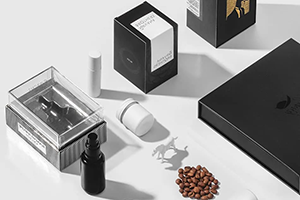
A necklace should arrive untangled, polished metal should stay unmarked, and the box should open with the care the brand promises. For jewellery and small fashion accessories, adapting paper packaging to the EU’s Packaging and Packaging Waste Regulation (PPWR) means understanding how the presentation box, product support and delivery pack achieve those results together.
The useful direction is a compact package with a clear purpose for each component, materials suited to recycling and evidence tied to the construction actually supplied. A paper-covered box may also contain plastic film, foam, fabric, adhesives and magnets. Its appearance tells only part of the story; the specification reveals what needs assessment.
Regulatory position: 22 September 2026. PPWR has applied generally since 12 August 2026. Several major requirements have later application dates, including harmonised sorting labels, the new packaging-minimisation requirements and recyclability grades.
Separate today’s duties from the next design milestones
For a brand buying packaging now, conformity documentation and supplier information are already relevant. The later dates matter because a box approved this season may be reordered for years. These are the principal milestones affecting jewellery and accessory packaging under Regulation (EU) 2025/40.
| Timing | What it means for the packaging |
|---|---|
| Now: general application began on 12 August 2026 | Meet the requirements currently applicable to the pack, including relevant substance restrictions, conformity assessment, technical documentation, an EU declaration of conformity, identification and responsible-operator information. Address applicable national extended producer responsibility obligations. |
| By 12 February 2028 | Operators filling sales packaging must reduce its empty space to the minimum necessary for packaging functionality, including product protection. This concerns the space inside the retail box. |
| 12 August 2028, or 24 months after the relevant implementing acts enter into force, whichever is later | The harmonised material-composition labelling requirement begins. Its timetable is separate from the identification and contact information already required. |
| From 1 January 2030 | Article 10 requires packaging weight and volume to be reduced to the minimum necessary for functionality, assessed against the criteria in Annex IV. |
| 2030 recyclability milestone, subject to the delegated-act timetable | The design-for-recycling grading framework becomes a market-access requirement. The finished packaging must meet the prescribed assessment; its percentage of paper alone does not establish a grade. |
| 1 January 2030, or three years after the empty-space implementing acts enter into force, whichever is later | A maximum 50% empty-space ratio applies to grouped, transport and ecommerce packaging, subject to the Regulation’s scope and exceptions. Filling materials count as empty space. |
Existing packaging requirements also continue through parts of the transition. The practical approach is to maintain conformity with the requirements applicable today while using the later milestones to guide new structures, material choices and artwork. A future deadline should inform the sample brief without being presented as a rule already in force.
Identify the packaging at each layer
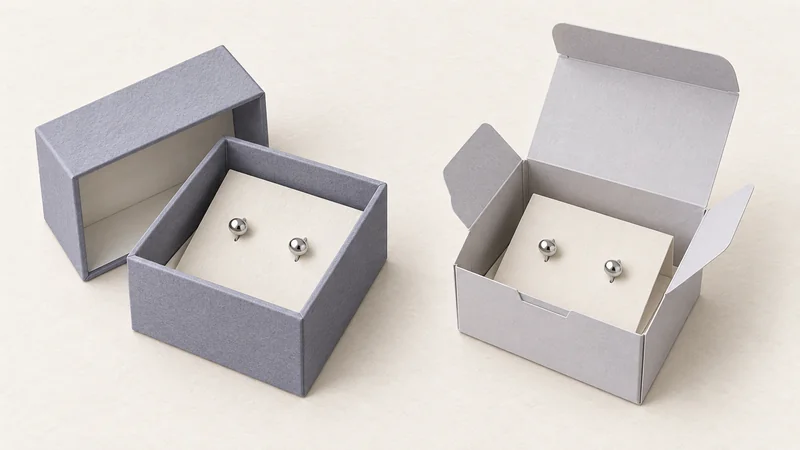
A presentation box supplied with earrings will normally be sales packaging: it forms the sales unit with the product. The insert holding the earrings belongs in the assessment of that pack. A separate carton used to deliver the order to an online customer is ecommerce packaging, a form of transport packaging. Tissue, sleeves, pouches and attached tags also need consideration where they perform a containment, protection, handling, delivery or presentation function.
Long life alone does not settle whether a case or pouch is packaging. A fabric pouch supplied to protect a bracelet can remain packaging even when the customer keeps it. A jewellery travel organiser sold as a product has a different role, and its own retail carton remains packaging. For a case supplied with an accessory, the integral-product exclusion depends on its relationship to that product: being integral, necessary to contain, support or preserve it throughout its lifetime, and intended to be used, consumed or disposed of together. Calling it a keepsake is insufficient to establish those conditions.
Keeping a gift box for storage is useful, but formal reusable-packaging status is a separate question. PPWR defines reuse around repeated use for the original purpose. Reusable packaging must meet the relevant design and reuse-system requirements; a customer’s possible second use does not establish that status on its own.
Give every structural layer a reason to be there
A rigid box can provide crush resistance, hold an insert securely and keep delicate components away from pressure. The minimisation assessment asks how much structure those functions require. Board thickness, wall construction, lid depth and internal platforms all deserve examination. From 2030, Article 10 targets features such as false bottoms and double walls when their only purpose is to increase perceived product volume. A reinforcement that prevents a stone setting from being crushed has a functional basis that can be assessed and supported.
Gift presentation has a place in that assessment. Annex IV expressly recognises packaging functionality associated with gifts and seasonal occasions, alongside protection, logistics and other needs. A support that presents a necklace clearly and lets the recipient lift it out safely can serve several purposes at once. Marketing appeal or consumer acceptance alone, however, cannot justify additional weight and volume. The design needs a reason for its dimensions beyond making a small item look larger.
When developing a pack, we can compare a compact lid-and-base rigid box with a folding carton using a similar product support. The carton may reduce material, while the rigid construction may offer protection the particular item needs. Packed samples reveal the trade-off more clearly than empty boxes. Range planning matters too: using one large box for both stud earrings and wide cuffs simplifies stockholding but leaves the smallest products poorly matched to their packaging. A few well-chosen sizes can preserve a consistent brand appearance with a closer fit.
Let the support do precise protective work
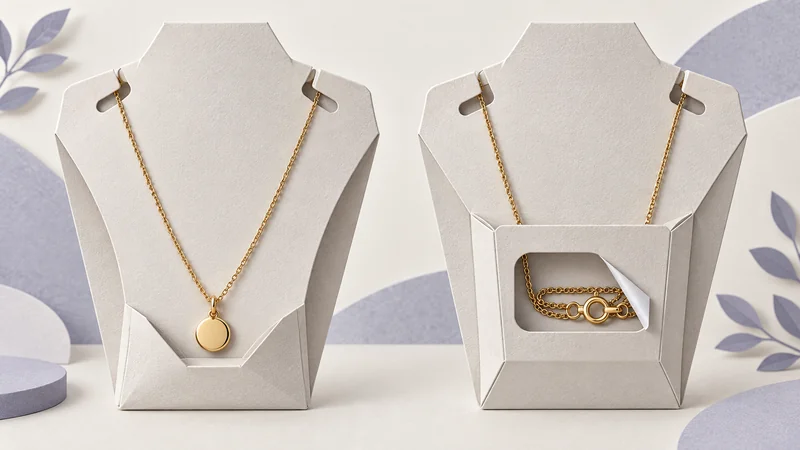
Consider a fine necklace laid across a presentation card. Two slots can position the chain, but the loose length behind the card still needs somewhere to go. A folded pocket or retaining feature can keep that length contained, while the pendant sits in a defined position. Without this detail, an attractive display can become a tangled bundle during transport. The support should hold the necklace without pulling hard on its clasp, trapping the chain beneath the lid or forcing the customer to drag it across a rough cut edge.
Other accessories set different limits. Earring posts can determine the necessary box depth even when the decorative fronts are tiny. A metal belt buckle may need separating from the leather beside it; a local divider can address that contact point without lining the entire box. These details explain why useful minimisation starts with the actual product and its vulnerable surfaces.
Paperboard supports can replace some foam constructions, but their contact surfaces and retention need checking. Polished metal, delicate coatings and fragile stones may still require a soft protective interface. For tarnish-sensitive jewellery, material compatibility also belongs in the assessment. Where a textile or foam element is necessary, investigate whether it can be limited to the contact area and removed easily. Then check that the support stays secure during handling and transport. Reducing material succeeds when the product remains properly protected.
Assess finishes and closures as part of the finished pack
PPWR’s recycling framework considers separation, sorting, processing and the quality of recovered material. Annex II identifies adhesives, coatings, colours, inks, closures and attached components as relevant parameters. A box containing mostly paper by weight can still present difficulties if its layers resist separation or interfere with recycling. The finished construction needs assessment, including the small elements hidden beneath the wrap.
A small foil logo and a fully metallised, plastic-laminated wrap create different material constructions. Describing both as a gold finish conceals the information needed to compare them. Specify the process, coverage, coating or film and adhesive, then assess the result. Blind embossing, paper texture and carefully controlled colour offer other ways to create distinction. Their appeal comes from proportion and touch, allowing a compact box to feel considered without relying on a large decorative shell.
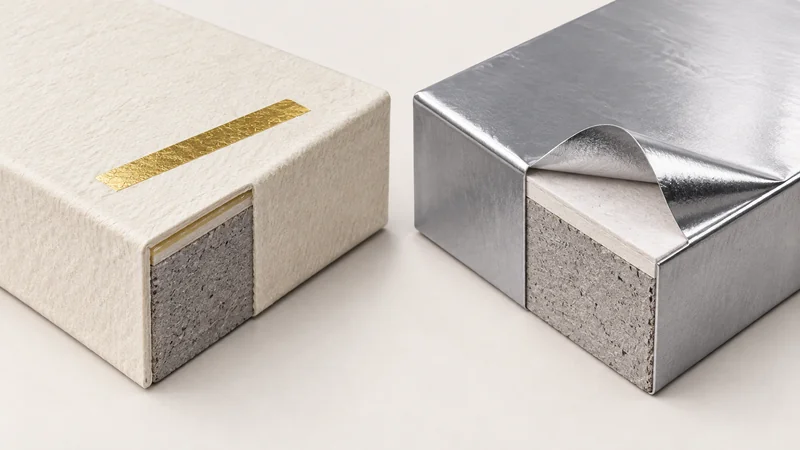
Closures connect the opening experience with material complexity. Magnets buried between board layers create a different separation problem from a removable pull tab. A lid-and-base box or drawer may offer another route, but its fit becomes important: a loose drawer can slide out during handling, while an excessively tight one opens with a sharp tug close to delicate contents. We can compare those movements in samples alongside the materials and fixing methods. Changing the closure should lead to a fresh check of retention, opening and protection.
Recycled content and recyclability describe different things. Recycled content concerns the material entering production; recyclability concerns what can happen to the finished pack after use. PPWR’s Article 7 minimum recycled-content targets concern plastic, rather than imposing a blanket recycled-fibre percentage on paper boxes. Plastic inserts or other plastic parts need their own scope assessment. Choosing recycled paper still leaves the box’s coatings, adhesives and mixed components to be considered.
Keep environmental wording as specific as the evidence. If a verified recycled-content figure concerns only the paper wrap, identify that component. For packaging properties subject to PPWR legal requirements, Article 14 permits environmental claims only about properties exceeding the applicable minimum requirements. It also requires the claim to identify whether it concerns a component, the packaging unit or the operator’s packaging as a whole, with support in the technical documentation.
Right-size the retail box and the shipping pack together
There are two distinct empty-space questions. Inside the retail box, the rule due by 12 February 2028 is to reduce space to the minimum necessary for functionality, including protection. Clearance around an earring post or room for a supported chain can have a practical purpose. The assessment concerns why that space is needed; it does not give every jewellery box a general 50% allowance.
For a separate ecommerce shipping carton, Article 24’s later 50% ceiling concerns the outer pack and the sales packaging contained within it. The comparison is therefore with the retail box, rather than the volume of the necklace alone. Paper cuttings, air cushions and foam fillers count as empty space. They may restrain the contents, but adding more of them does not improve the empty-space ratio.
An illustrative design check: a retail box measuring 120 × 90 × 40 mm externally occupies 432 cm³. A shipping carton with an internal space of 180 × 130 × 70 mm provides 1,638 cm³. A simple volume comparison leaves about 74% empty space: (1,638 − 432) ÷ 1,638. Filling the gaps with shredded paper leaves that comparison unchanged. These figures help identify a pack worth redesigning; the legal assessment must follow the applicable implementing methodology.
A closer-fitting carton and a support that controls movement may reduce the need for loose fill. That change still needs enough protection against impact and compression, along with usable space for the shipping label. Article 24 requires the calculation methodology to account for circumstances including fragile or very small products and label space. Enlarging the retail box simply to fill the parcel would move the excess inward, where the sales-packaging and minimisation requirements still matter.

For some accessories, a sales box designed to travel directly to the customer can remove an entire layer. Article 24 exempts sales packaging used as ecommerce packaging from the 50% obligation, while retaining the Article 10 minimisation requirement. Suitability depends on the journey: the box must close securely, carry the delivery information and protect both the product and the presentation the recipient will see.
Assign responsibilities when sourcing from China
PPWR’s legal manufacturer can be the brand commissioning the packaging. Under the own-name or trademark rule, a brand having packaging or a packaged product designed or manufactured for it will generally hold that role, with responsibility for the conformity assessment, technical documentation and EU declaration of conformity. The limited micro-enterprise exception requires the packaging supplier to be in the same Member State; sourcing from China does not satisfy that condition.
The EU-established entity placing packaging from a third country on the EU market has importer duties, including checking the required conformity work and documents. Roles can overlap. The producer responsible for extended producer responsibility (EPR) is another determination, linked to the supply route and relevant Member State. EPR concerns responsibility for packaging waste, including applicable registration, reporting and financial obligations. An EU declaration of conformity addresses packaging conformity; destination-market EPR arrangements still need to be covered, particularly for direct online sales across borders.
Keep evidence tied to the approved packaging version
Article 16 requires packaging suppliers to provide the information and documentation the manufacturer needs to demonstrate conformity. For a custom jewellery box, a useful handover connects the physical sample with the materials and evidence behind it. The working record should make the following information easy to match:
- The approved construction: drawings, dimensions, component weights and the specified papers, board, inserts, finishes, adhesives and closures.
- The packaging’s function: how the product is packed and supported, what limits further reduction, and the relevant fit, handling or transport assessments.
- Material evidence: supplier information and relevant declarations or test reports, identifiable against the selected material, colour and construction.
- Conformity and traceability: the applicable requirements, assessment basis, EU declaration of conformity, packaging identification and responsible-operator details.
One relevant substance requirement is the combined 100 mg/kg limit for lead, cadmium, mercury and hexavalent chromium in packaging or packaging components. Inks, coatings, adhesives and other components belong in the evidence review alongside the main paper materials. The information needed depends on the actual specification; a general statement about paper cannot resolve questions about every added component.
A laboratory report supports the submitted sample and the tests it describes. A four-heavy-metal pass can contribute to the evidence for that restriction, but it does not establish recyclability, tarnish protection or conformity with every PPWR obligation. Match the report to the relevant material and version, and account for changes in colour, formulation or supplier. This makes testing useful to the project rather than treating a report title as a general approval of the box.
That connection must survive repeat orders. An adhesive substitution or a new laminated wrap can change the basis of the assessment even when the box looks similar. Article 15 requires reassessment where changes could affect conformity. Manufacturers must retain the technical documentation and EU declaration of conformity for five years for single-use packaging and ten years for reusable packaging, measured from placing on the market.
Develop the sample and its evidence together
At CMIC, we can help turn a broad request such as a smaller premium jewellery box into a few meaningful alternatives: a revised footprint, a paperboard support, a different closure or a finish with a simpler material construction. Through our EU packaging solutions, we can develop the structure, compare packed samples and coordinate suitable supplier information and project-specific testing. The comparison can cover appearance, opening feel, protection, cost and production practicality alongside the evidence each option needs.
To begin, contact us with the product, your current packaging or reference, and the EU markets and delivery routes involved. A useful sample review brings the whole experience together: the necklace’s position, the surface touching the metal, the movement of the lid and the fit inside the parcel. Those details give the revised specification its purpose—and preserve what the customer values when the package arrives.